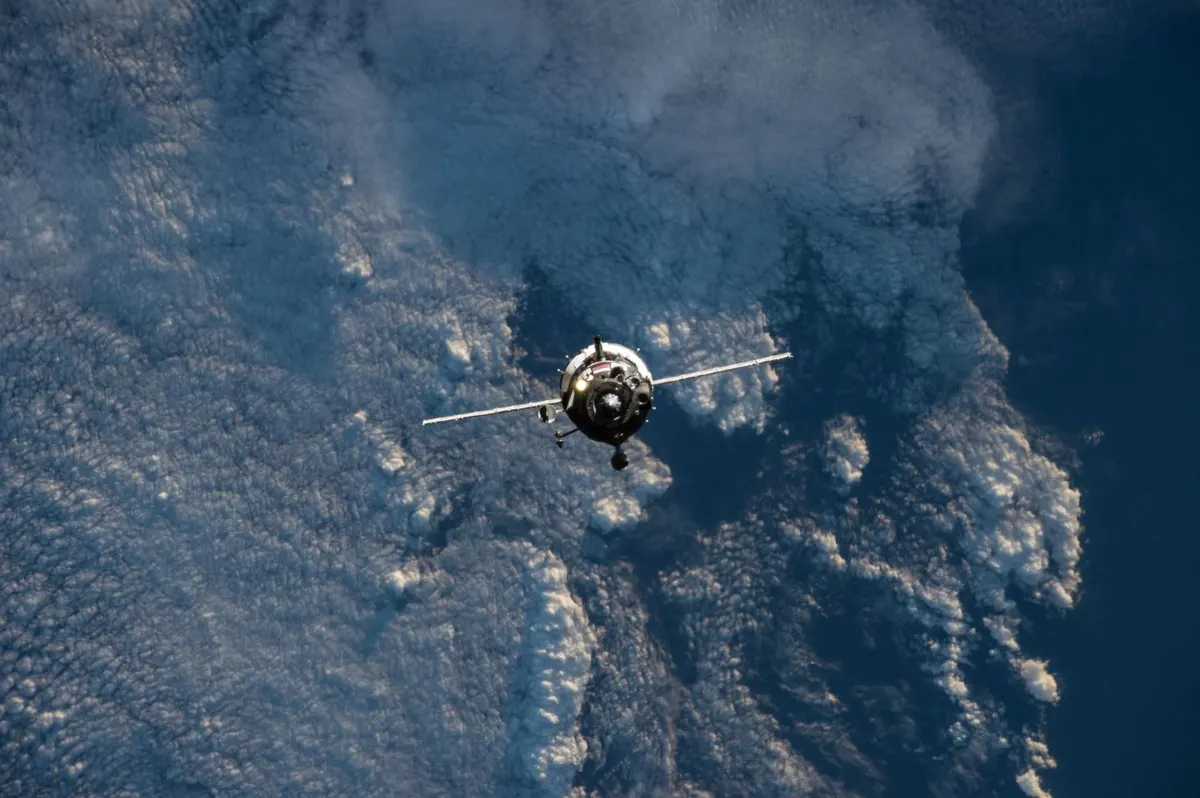
The country that started it all ranks fourth
Russia owns 375 active satellites as of October 17, 2026, 2.2% of the world total, behind the United States, China and the United Kingdom. That's a long way down for the country whose Soviet predecessor launched Sputnik 1 from Tyuratam (now Baikonur) on October 4, 1957. The ranking counts satellites flying now, not history, and the biggest new fleets are constellations of hundreds or thousands of small satellites. Russia has only just begun one.
GCAT keeps the two eras apart. Russia's launch count starts in 1992 and stands at 900, and the Soviet Union's 2,457 launches are counted separately. In orbit, Russia had 684 payloads, working or not, at the end of 2025, up from 288 at the end of 2005. Of those, 55% are active, so close to half of what Russia has put up and left in orbit is no longer working.
What they do
Communications accounts for 167 of Russia's active satellites (45%).
Where they orbit
Who operates them
The largest operators, and the largest families of satellites, owned by Russia.
By operator
By satellite family
Operator names are as written in GCAT, usually transliterated from the original language. Families group satellites by the first word of their name.
How the fleet has grown
At the end of 2005, Russia had 288 payloads in Earth orbit. By the end of 2025 it had 684.
Launches
Russia has made 900 orbital launch attempts since its first in 1992, and 17 of them in 2025. Its busiest year was 1992 with 55. The Soviet Union made another 2,457 before 1992, which GCAT counts separately.
Kosmos, the name that hides a program
The biggest family in the fleet is Kosmos, with 116 active satellites. The word is Russian for outer space, and the name covers almost all Soviet and Russian military satellites plus some science craft and some that failed soon after launch. The first Kosmos flew on March 16, 1962. So a Kosmos number tells you only that the satellite is Russian, and whoever wants to know what it does has to work it out from its orbit.
The operator table points the same way. The aerospace forces, listed as VVKO VKS, have 48 satellites, and the defense ministry, listed as MO RF, has 17. By function, communications account for 167 of Russia's 375 active satellites.
Gonets, an older communications network
Gonets, with 15 active satellites, is Russia's low-orbit communications system. The first test satellites launched on July 13, 1992 and the first operational ones on February 19, 1996. The operator is Gonets SatCom, privatized in 1996.
That makes Gonets a small network renewed over three decades. Rassvet, below, is the first sign of a larger one.
A new constellation
The newest family is Rassvet, with 38 satellites, built by Bureau 1440, which began in 2020 as a MegaFon project office. Of the 38, 32 come from two operational batches of 16 launched from Plesetsk, the first on March 23, 2026 and the second on July 19, 2026. The company's plan is about 900 satellites by 2035. Set that beside Starlink and the scale gap is plain, though one fleet is years older than the other.
Fewer launches, fewer satellites
Russia launched 17 times in 2025, against 181 for the United States and 92 for China. Its busiest year in the post-Soviet count was 1992, the first year of the count, with 55 launches. The sites it uses, from Baikonur to Plesetsk to Vostochny, are on the launches from Russia page.
Russia launches its own, too: 374 of its 375 active satellites flew on Russian rockets and 1 on American rockets. By orbit, it has 223 satellites in the lowest band, 76 in the upper low band, 34 in medium Earth orbit and 31 in geosynchronous orbit. The geostationary page shows who else parks there, and Russia's early attempts at Mars are on the countries that reached Mars page.