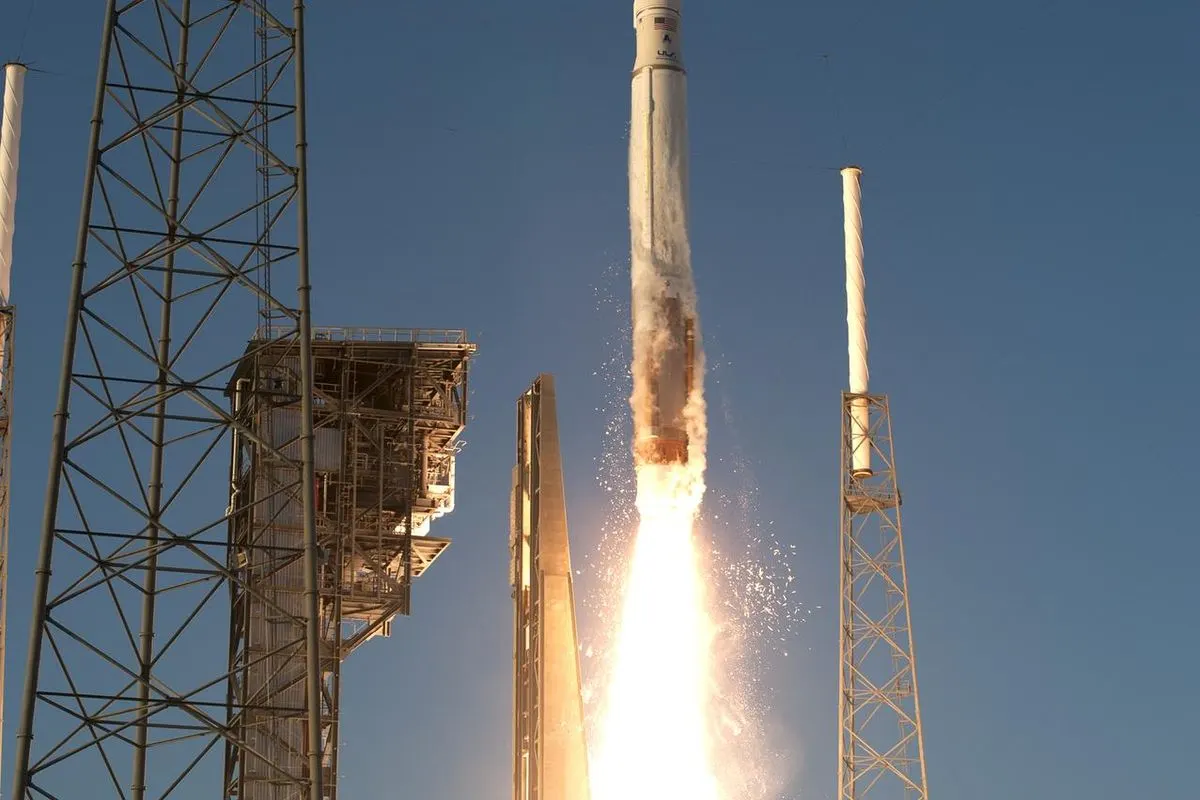
Amazon's network, still being built
As of October 17, 2026, 392 Kuiper satellites are active, from 398 launched on 15 launches. The FCC approved a constellation of 3,236 satellites in July 2020, since trimmed to 3,232, so the network is about 12% of the way there by launches.
Amazon announced the project in April 2019. It renamed it Amazon Leo in November 2025, but GCAT still lists the satellites as Kuiper, and so does this page.
Kuiper satellites have flown on 15 launches since October 6, 2023, carrying 398 satellites.
Satellites launched per year
Data table
| Year | Launches | Satellites |
|---|---|---|
| 2023 | 1 | 2 |
| 2025 | 7 | 180 |
| 2026 | 7 | 216 |
Rockets used
Where they orbit
Atlas V 551 has carried the most Kuiper launches, 8 of 15.
A slow start and a sudden pace
Two prototype satellites flew on October 6, 2023. The first production batch, 27 satellites, followed on April 28, 2025. Launches then picked up: 7 in 2025 carrying 180 satellites, and 7 in 2026 through October 16, 2026 carrying 216.
The rocket table is varied: Atlas V 551 with 8, Falcon 9 with 3, Ariane 64 with 3 and Atlas V 501 with 1. The Atlas V launches leave from Florida.
A big order for rockets
Amazon booked many launches before it flew any of its own satellites: nine Atlas V launches (April 2021), 83 launches including 18 Ariane 6, 12 New Glenn and 38 Vulcan (April 2022), three Falcon 9 (December 2023), plus more in 2026. Against the first contract for nine Atlas V launches, Atlas V has flown 9 times, counting the prototype launch. Falcon 9 has flown 3 times against a contract for three, and Ariane 6 has flown three times. No Kuiper launch on New Glenn or Vulcan appears in the log.
The mix includes SpaceX, a competitor, as a supplier. The SpaceX page shows how large that company's own launch rate is.
What it is meant to do
Satellites talk to each other over optical inter-satellite laser links. The planned constellation is 3,232 satellites, the number the FCC authorizes after a 2024 trim from 3,236. Amazon plans three customer terminals: Nano (up to 100 Mbps), Pro (400 Mbps) and Ultra (up to 1 Gbps down). Amazon said in July 2026 that initial service in certain latitudes was planned for later in 2026.
One early customer deal is a distribution agreement with South Africa's Herotel, reported in July 2026, with South African connections expected in 2027. The FCC license also requires the rest of the constellation by July 30, 2029.
The pace, by comparison
Kuiper averaged 25.7 satellites per launch in 2025 and 30.9 in 2026 through October 16, 2026. In the same data, Starlink launched 833 satellites in 2020, its second year of launches, against Kuiper's 180 in its first full year.
The difference is the rocket supply: Starlink flew on its owner's own Falcon 9, and Amazon is buying launches from several companies.
Launches still to come
The contracts include 38 Vulcan launches and 12 New Glenn launches, and neither rocket appears in the Kuiper log yet. Vulcan first flew on January 8, 2024 from SLC-41, carrying the Peregrine lunar lander, and New Glenn first flew on January 16, 2025 from Launch Complex 36.
The prototype launch of October 6, 2023 is listed in GCAT as an Atlas V 501 carrying 2 satellites. After it came a gap of more than a year and a half before the production batches began.
The deadline
The FCC's license required half the constellation, 1,616 satellites, by July 30, 2026. In January 2026 Amazon asked for more time. On June 5, 2026 the FCC's Space Bureau granted a limited waiver of the July 2026 milestone and temporarily lowered the spectral priority of satellites launched after that date until Amazon builds faster, while keeping the July 30, 2029 deadline for the full constellation.
One reference counts 396 production satellites plus 2 prototypes as of July 2026, which fits GCAT's 398 launched. By that count the network was at about 25% of the 1,616 required, when the data was last updated.
Next to the others
Kuiper's 392 active satellites are 2.3% of the 17,101 in orbit as of October 17, 2026. They compare with 11,137 for Starlink and 652 for OneWeb.
Across its 15 launches Kuiper has averaged 26.5 satellites each. GCAT credits them to the United States, and the United States page shows how much of that fleet is now Kuiper.