The burst nobody trusted
The first fast radio burst sat in an archive for six years. Duncan Lorimer had asked his student David Narkevic to look through old pulsar survey data from the Parkes radio dish in Australia, and in 2007 Narkevic found a flash of radio waves that had arrived on 24 July 2001. It was short, bright and had traveled a long way: the signal was smeared in a way that showed it had crossed far more free electrons than our galaxy holds. Nothing repeated in 90 hours of follow-up, so for a while it looked like a one-off. Skeptics had a natural suspicion. Single, bright, brief flashes are what interference from Earth looks like.
They had a reason to suspect it. In 2010 the same dish recorded 16 similar pulses that were clearly local. Astronomers named them perytons, and it took until 2015 to find the cause: microwave ovens, whose magnetrons emitted a burst when somebody opened the door during a heating cycle. The bursts that remained, the ones that weren't ovens, had to be something else.
The repeater that changed the question
The idea that fast radio bursts were all one-time explosions broke when a source in the direction of Auriga, FRB 121102, was detected from Arecibo in 2012 and turned out to repeat. Paul Scholz found ten repeat bursts in archival Arecibo data from 2015, and in 2017 the source was traced to a galaxy about three billion light years away. That mattered because a repeating source can't be a cataclysm that destroys its source. It also split the field into repeaters and one-offs, a division that, as the catalog numbers above show, is still being worked out.
How they were found
In 2007 astronomers searching archived pulsar survey data found a burst of about 30 janskys lasting less than 5 milliseconds, located three degrees from the Small Magellanic Cloud. It didn't come from our galaxy or the Magellanic Cloud, and its distance was less than 1 gigaparsec. No more bursts came from the spot in 90 hours of follow-up, so the team suggested it was a single event, such as a supernova or the merger of dense objects, and guessed that hundreds of similar events might occur every day.
That guess turned out to be about right. The first CHIME catalog, which covers 25 July 2018 to 1 July 2019, lists 536 bursts. Of those, 62 came from 18 sources that repeat. Repeaters and one-off bursts are spread across the sky the same way, but repeaters differ in how long each burst lasts and how wide a range of radio frequencies it covers. CHIME estimates about 525 bursts per day over the whole sky above a fluence of 5 Jy ms at 600 MHz.
| When | What happened |
|---|---|
| 2007 | Lorimer et al. report a single burst of about 30 janskys lasting less than 5 milliseconds, found in archive data three degrees from the Small Magellanic Cloud. |
| 25 July 2018 to 1 July 2019 | CHIME detects 536 bursts, including 62 from 18 repeating sources. |
| 28 April 2020 | The Galactic magnetar SGR 1935+2154 fires a burst detected by CHIME and the STARE2 array. |
| 4 March 2024 | FRB 20240304B is detected by MeerKAT. Its host galaxy is later measured by Webb (announced 8 October 2026). |
A burst from inside our galaxy
On 28 April 2020 the magnetar SGR 1935+2154, a highly magnetized neutron star in the Milky Way, produced an intense radio burst. The STARE2 array recorded a fluence of about 1.5 million jansky milliseconds and found it was about 4,000 times more energetic than any Galactic radio burst seen before on similar timescales, yet 40 times less energetic than the weakest extragalactic burst seen so far. CHIME put its energy at about 3 × 1034 erg, three orders of magnitude brighter than any radio-emitting magnetar before it. Both teams said that such a burst from a nearby galaxy would look like an ordinary FRB, which strongly supports magnetars as the source of at least some of them.
Flashlights for the invisible matter
Because each burst picks up a delay from every free electron it crosses, bursts can be used to weigh the ordinary matter between galaxies. Using four new localizations, redshifts 0.118, 0.291, 0.378 and 0.522, Macquart and colleagues weighed the ordinary matter between galaxies and found an ordinary-matter density of 0.051, in the paper's units (the ordinary-matter density times the Hubble parameter divided by 70), with uncertainties of plus 0.021 and minus 0.025, consistent with the early-universe values. They note that more than three quarters of ordinary matter is spread very thinly, which makes it hard to see any other way.
The record holder
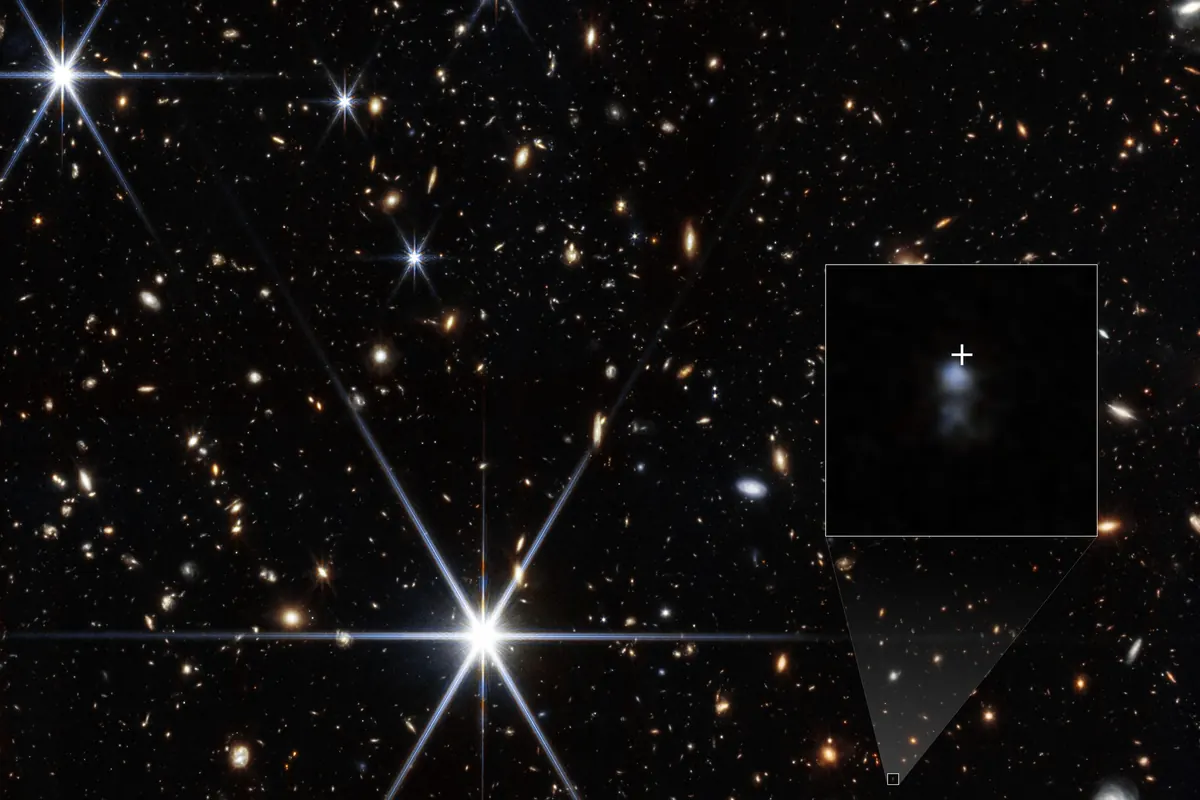
NASA announced on 8 October 2026 that Webb had found the home of FRB 20240304B. The MeerTRAP team, using the MeerKAT telescope, detected it on 4 March 2024. The host is a small dwarf galaxy at a redshift of 2.148, 3 billion years after the big bang, and it's 1,000 times less massive than the team expected. Most of its stars appear to have formed within just 30 million years. That favors a magnetar, which can form soon after a massive star explodes, over a merger of two neutron stars, which should take billions of years. The lead author said it's very unlikely this burst came from a merger. Its signal also carried the imprint of two structures it crossed: a galaxy cluster at a redshift of 0.3 (about 3.5 billion light-years away) and the Virgo Cluster, about 54 million light-years from Earth.
Measured: we know this
- 536 bursts were catalogued by CHIME in one year, including 62 from 18 repeating sources.
- A burst from the Galactic magnetar SGR 1935+2154 on 28 April 2020 bridged most of the energy gap between known magnetars and FRBs.
- FRB 20240304B's host galaxy is at a redshift of 2.148.
Inferred: we think this
- At least some FRBs come from magnetars. The Galactic burst strongly supports it.
- Merging neutron stars are an unlikely source for the record-holder, because its host galaxy formed most of its stars within 30 million years.
Unknown: we don't know
- What generates all FRBs. NASA says we have theories but no conclusive proof, and most bursts are seen only once.
- Why repeaters differ from one-off bursts in duration and bandwidth.
What would settle it
- More localized bursts. MeerKAT may find several fast radio bursts per year beyond redshift 1.0, and Webb will be needed to study their host galaxies.
In human terms
- A burst lasts about a thousandth of a second, yet the farthest known one crossed space for about 10.7 billion years before it arrived, because its host galaxy is seen as it was only 3 billion years after the big bang.
Questions people ask
What's a fast radio burst?
A flash of radio waves lasting about a thousandth of a second, from far beyond our galaxy. Most are seen once and never again.
Do we know what causes fast radio bursts?
Not for certain. A burst from the Milky Way magnetar SGR 1935+2154 in 2020 strongly supports magnetars as the source of at least some of them, but there's no conclusive proof.
How far away is the farthest fast radio burst?
FRB 20240304B, announced in October 2026, came from a galaxy at a redshift of 2.148, 3 billion years after the big bang.
 James Webb Space TelescopeThe telescope that found the record burst's home.
 The Wow! signalA radio mystery from 1977.
 Dark matterThe other thing nobody can see.
 All mysteriesEvery open question on the site.
Theories in the queue
The best-supported explanation is a magnetar, a neutron star with an immense magnetic field, and the Milky Way burst of April 2020 gave it its strongest evidence. Other ideas include collisions between very dense objects and, in some proposals, links to gamma-ray bursts or energetic supernovae. The list also includes more exotic ideas, from cosmic strings to the decay of hypothetical dark matter particles. Extraterrestrial intelligence has been speculated about, though not by the discoverers of the burst FRB 180814. Each of these ideas makes a different prediction about where the bursts should happen, and that's what the new localizations are for.
What to watch next
The record-holder in the box above has a host galaxy that we see as it was about three billion years after the big bang, and that host is far smaller than predicted, which points toward young magnetars and away from slow-forming mergers. If more distant bursts show the same thing, the picture firms up, and Webb is the telescope that can look at their hosts. If they don't, there may be more than one kind of source. For the other signals from space that have a natural explanation or haven't found one, see the Wow! signal, and for what bursts can tell us about the matter between galaxies, see the other unsolved problem of the dark matter.